SaaS growth rate benchmarks in 2026, by ARR stage and funding model
What a private B2B SaaS company should grow in 2026 at each ARR stage, why surveys say 20% while billing data says 3.6%, and how to read your own number.

The median SaaS growth rate in 2026 is 20% to 22% for private B2B companies that answer surveys, and 3.6% in billing data from more than 1,500 software sellers. Both numbers are right. They count different companies, and that gap decides how you should read every benchmark.
Five sources frame this guide. SaaS Capital's growth brief comes from its 15th annual survey of more than 1,000 private B2B SaaS companies, and SaaS Capital is a lender to SaaS companies. Benchmarkit's report of 1 June 2026 asked 338 companies about 2025 growth. Maxio's B2B Growth Report reads cash billings on its own platform, and Maxio sells billing software. Kyle Poyar's summary of the High Alpha 2025 SaaS Benchmarks covers 800+ companies, and his newsletter is sponsored by Metronome, a usage billing vendor. Listed companies come from Clouded Judgement.
Key figures 2026
| Indicator | Value | Scope | Period | Source |
|---|---|---|---|---|
| Median growth, private B2B SaaS | 22%, from 25% | 1,000+ companies, survey | 2025 vs 2024 | SaaS Capital, 2026 |
| Median growth, bootstrapped vs equity-backed | 20% vs 25% | Same survey | 2025 | SaaS Capital, 2026 |
| Median growth, all respondents | 20%, from 30% in 2022 | 338 companies | CY 2025 | Benchmarkit, June 2026 |
| Median growth in cash billings | 3.6% | 1,500+ sellers on Maxio | Year over year, report of Sept. 2026 | Maxio, Sept. 2026 |
| Companies shrinking | 42.4% | Same sellers | Same period | Maxio, Sept. 2026 |
| Median growth, listed software | 16% trailing, 13% expected | Listed companies | Edition of 30 Oct. 2026 | Clouded Judgement, Oct. 2026 |
| Median growth at $1M to $5M of ARR | 110% AI-native, 40% B2B SaaS | 800+ companies | Survey of Aug. and Sept. 2025 | Poyar, Nov. 2025 |
What is a good SaaS growth rate in 2026?
A good SaaS growth rate in 2026 is anything above the median of your ARR band, which for most private B2B companies means 20% to 26% a year. The 75th percentile sits near 42% across all sizes, and the median companies themselves are growing more slowly every year.
Private B2B SaaS companies grew at a median of 22% in 2025, down from 25% in 2024, in SaaS Capital's 2026 survey of more than 1,000 private companies. Benchmarkit's 338 companies had a median of 20% in calendar year 2025, down from 30% in 2022, and its 75th percentile fell from 75% to 42% over those four years (Benchmarkit, June 2026). A company growing 30% therefore beats the median in both surveys without reaching the top quartile. Benchmarkit puts the floor of its second quartile at 8%, so below that you sit in the bottom quarter. Only 7.3% of SaaS Capital's respondents reported flat or negative growth in 2025, against a peak of 13% in 2020. These are medians of reported growth, so half of the companies in each survey grew faster than the figure.
Founders also plan higher than they deliver. Benchmarkit's companies planned a median 26% for 2026 after growing 20% in 2025, the fourth year in a row that plans beat results.
Why do surveys say 22% while billing data says 3.6%?
The surveys and the billing data measure different companies in the same market. SaaS Capital and Benchmarkit collect answers from companies that choose to take part, and Maxio measures what its customers billed.
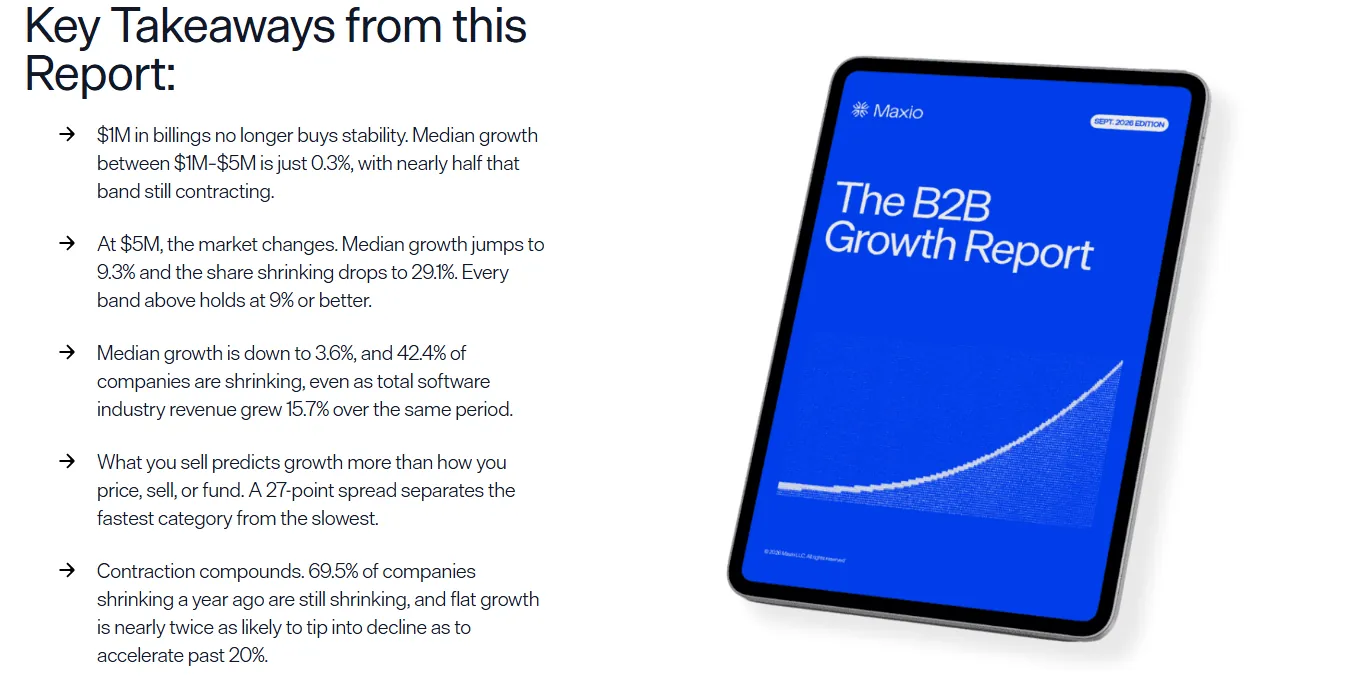
Maxio compares each company with its own billings a year earlier, keeps only companies with twelve full months of billing on both sides, and reports medians so that no outlier skews the result. Every figure rests on money actually billed, with no survey and no self-reported ARR. Across more than 1,500 private B2B software sellers, the median company grew 3.6% while total software industry revenue grew 15.7% over the same period, and it writes that the spending "is concentrating in fewer companies" (Maxio, 2026 B2B Growth Report, September 2026). The full report sits behind a form, so we read only its public summary.
Treat them as different measures. A survey shows where engaged companies sit, and billing data shows what happened to a broad base of sellers. Never compare a number from one family with the other, and compare years only inside one source.
How fast do SaaS companies grow at each ARR stage?
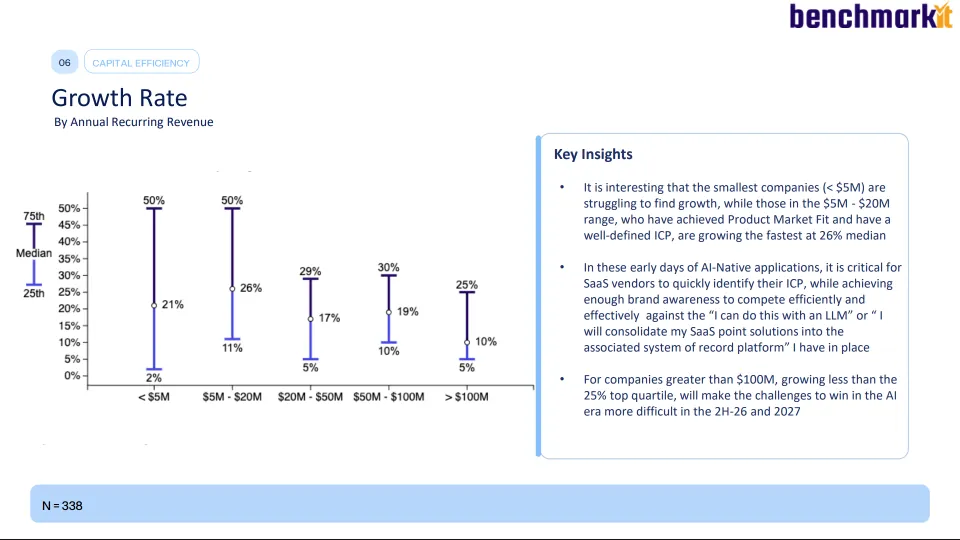
Median growth falls as ARR rises in both datasets, but not in a straight line. Benchmarkit's companies grow fastest between $5M and $20M of ARR, at a median of 26%, and slowest above $100M, at 10%.
| ARR | Median growth | 25th to 75th percentile |
|---|---|---|
| Under $5M | 21% | 2% to 50% |
| $5M to $20M | 26% | 11% to 50% |
| $20M to $50M | 17% | 5% to 29% |
| $50M to $100M | 19% | 10% to 30% |
| Over $100M | 10% | 5% to 25% |
Those values come from the growth chart of Benchmarkit's June 2026 report, calendar year 2025, 338 companies. Benchmarkit says companies under $5M are struggling to find growth, while those at $5M to $20M have found product-market fit and a clear customer profile. It adds that a company above $100M growing below the 25% top quartile will find the AI era harder in the second half of 2026 and in 2027.
Do smaller companies grow faster?
It depends on the sample. In the High Alpha 2025 survey, summarized by Kyle Poyar in November 2025, B2B SaaS companies under $1M of ARR had a median growth of 75%, then 40% at $1M to $5M, 30% at $5M to $20M, 35% at $20M to $50M and 15% above $50M (table below). Benchmarkit's companies under $5M grow more slowly than its $5M to $20M group. The bands differ between the two sources, so use each one on its own bands.
Do bootstrapped companies grow slower than funded ones?
Yes, a little. Bootstrapped companies in SaaS Capital's survey grew a median of 20% in 2025, down from 23% in 2024, and equity-backed companies grew 25%, unchanged.
Among bootstrapped companies between $3M and $20M of ARR, the median was 15% and the 90th percentile 42.3%, down from 20% and 51% a year earlier. Their median NRR was 103% and their median gross revenue retention 91% (SaaS Capital, benchmarking metrics for bootstrapped SaaS companies, 24 April 2026). The two bootstrapped medians, 20% and 15%, describe different groups, all sizes in one case and the $3M to $20M band in the other.
How much faster do AI-native companies grow?
AI-native companies grow faster than B2B SaaS companies at every ARR band in the High Alpha 2025 data, and Poyar sums the gap up as three times faster. Among its 800+ respondents, 36% said AI is core to their product and 64% called it a supporting feature.
| ARR | B2B SaaS median | AI-native median |
|---|---|---|
| Under $1M | 75% | 100% |
| $1M to $5M | 40% | 110% |
| $5M to $20M | 30% | 90% |
| $20M to $50M | 35% | 60% |
| Over $50M | 15% | 40% |
The best early-stage startups are accelerating, too. In the High Alpha 2025 survey of 800+ companies, the top quartile of B2B software companies under $1M of ARR grew 300% year over year, against 250% in 2024 and 150% in 2023. A typical respondent in that survey was a US-based B2B SaaS company with $5M to $20M of ARR (Poyar, November 2025). ICONIQ calls the fastest private companies Pacesetters, young AI-forward businesses that go from $1M to $100M of ARR in two to four years, less than half the time of incumbent software companies. Roughly 70% or more of their gross new revenue comes from new logos, their net retention runs 120% to 146%, and they spend roughly 2.3 times more than peers at earlier stages (ICONIQ, 2026 State of Scaling, September 2026).
Benchmarkit's sample points the other way for some categories. It writes that AI-native application companies find growth harder than expected as new entrants multiply, and it reports a median of 24% for vertical SaaS and AI companies against 17% to 19% for horizontal ones. The datasets select different companies, so read the AI premium as a feature of the fast-growing tail, not as a promise for every AI product.
What separates fast growers from slow ones?
Net revenue retention and sales efficiency separate fast growers from slow ones more clearly than price or contract size do. In SaaS Capital's 2026 survey of more than 1,000 private B2B SaaS companies, moving from 90%-100% NRR to 100%-110% raised median growth by 5 percentage points, and the companies with the highest NRR grew a median 173% faster than the survey population. The same survey found no overall link between average contract value and growth, so a higher price alone does not buy speed. NRR above 100% means existing customers expand faster than they leave, which gives a company growth before it signs a single new logo. SaaS Capital calls this a rare example of increasing returns from investing in upsells and cross-sells (SaaS Capital, 2026).
Poyar's data crosses retention with CAC payback and finds a wide spread in average growth, and the table below shows what share of respondents sits in each cell (Poyar, November 2025).
| Retention and payback | Share of respondents | Average growth |
|---|---|---|
| High NRR, short CAC payback | 13% | 71% |
| High NRR, long CAC payback | 15% | 40% |
| Low NRR, short CAC payback | 15% | 30% |
| Low NRR, long CAC payback | 12% | 10% |
Maxio adds a warning about direction. It found that 69.5% of companies shrinking a year earlier were still shrinking, and that a company with flat growth was nearly twice as likely to fall into decline as to pass 20% growth. It also found a 27-point spread in growth between its fastest and slowest software category, so what you sell predicts growth better than how you price, sell or fund it (Maxio, September 2026).
Our guide to SaaS metrics explains how to measure NRR, and our guide to the CAC payback period covers the other axis of Poyar's matrix.
Why does growth slow as a SaaS company gets bigger?
The same percentage needs more new revenue each year. A company at $5M of ARR growing 20% adds $1M, and one at $100M adds $20M (our calculation, ARR times growth rate).
Size explains most of the decay in listed companies. SaaS Capital measured an R-squared of about 0.85 between median revenue growth and median revenue size across its public SaaS index over the decade to early 2024, and found that growth had fallen from its 2021 peaks in every size bucket (SaaS Capital, February 2024). Listed software companies reached a median trailing growth of 16%, with 109% median net retention, in Clouded Judgement's 30 October 2026 edition. Our guide to SaaS pricing models shows how pricing architecture affects that retention.
How do you benchmark your own growth rate?
Compare like with like: the same growth definition, the same ARR band and the same funding model. Five steps cover it.
- Compute your growth the way the survey does. Divide ARR today minus ARR twelve months ago by ARR twelve months ago. Maxio uses billings, so a billing-based figure belongs next to Maxio's numbers and an ARR-based figure next to SaaS Capital's.
- Place yourself in a band. Use Benchmarkit's five bands or Poyar's, not a blend, and read the 25th and 75th percentiles, not only the median.
- Pick the right funding group. Bootstrapped companies had a 20% median in SaaS Capital's survey and equity-backed ones 25%.
- Check NRR next. If NRR is below 100%, fix retention before buying growth, since SaaS Capital ties higher NRR to faster growth.
- Translate the rate into time. Doubling time is ln 2 divided by ln of 1 plus the growth rate. At 26%, the Benchmarkit median for $5M to $20M, ARR doubles in 3.0 years. At 10%, the median above $100M, it takes 7.3 years, and at 3.6% it takes 19.6 years (our calculation).
An $8M company growing 24% reaches $9.92M in twelve months and doubles in 3.2 years. It sits just under the Benchmarkit median of 26% for its band and far from the 75th percentile at 50%.
If you land below the median of your band, read your NRR and CAC payback before you plan new spend. Our CRM comparison for startups helps if pipeline data is the weak link.
Frequently asked questions
What is the average SaaS growth rate?
It depends on the dataset. SaaS Capital's survey of more than 1,000 private B2B companies gives a median of 22% for 2025, and Benchmarkit's 338 companies give 20%. Maxio's billing data gives 3.6% because it measures sellers on its billing platform, not only companies that answer surveys.
How fast should a $10M ARR SaaS company grow?
Benchmarkit's median for companies between $5M and $20M of ARR is 26%, with a 25th percentile of 11% and a 75th percentile of 50%. The High Alpha 2025 survey, summarized by Kyle Poyar, reports a median of 30% for B2B SaaS companies in the same band. Anything above 30% puts you ahead of most peers.
Is 20% growth good for a bootstrapped SaaS company?
Yes, it matches the median. Bootstrapped companies in SaaS Capital's survey grew 20% in 2025, against 25% for equity-backed companies. Among bootstrapped companies between $3M and $20M of ARR the median was 15% and the 90th percentile 42.3%, so 20% already beats the median of that group.
Does higher net revenue retention mean faster growth?
In SaaS Capital's data, yes. Moving from 90%-100% NRR to 100%-110% raises growth by 5 percentage points, and the companies with the highest NRR grew a median 173% faster than the survey population. Average contract value showed no overall link with growth.
Should you plan for higher growth than last year?
Only if your unit economics support it. Benchmarkit's companies planned a median 26% growth for 2026 after delivering 20% in 2025, and planned growth has beaten actual growth four years in a row. Build the plan on your trailing numbers and add investment when payback and retention are in the top quartile.
Sources
- 01SaaS Capital, 2026 Private B2B SaaS Company Growth Rate Benchmarks (2026)
- 02SaaS Capital, 2026 Benchmarking Metrics for Bootstrapped SaaS Companies (April 2026)
- 03SaaS Capital, Why Long-Term SaaS Revenue Growth Rates are Slowing (February 2024)
- 04Benchmarkit, 2026 SaaS and AI Metrics Benchmarks report (June 2026)
- 05Maxio, 2026 B2B Growth Report (September 2026)
- 06Kyle Poyar, New data from 800 companies in the 2025 SaaS Benchmarks report (November 2025)
- 07High Alpha, 2025 SaaS Benchmarks Report (2025)
- 08Jamin Ball, Clouded Judgement 10.30.26 (October 2026)
- 09ICONIQ, 2026 State of Scaling, The Great Sorting (September 2026)