SaaS pricing models in 2026, with data on retention, margin and AI pricing
Seat, usage, hybrid or outcome pricing? What 342 software companies and 230 software companies report for 2026, plus the public price points of Salesforce and Intercom.

Hybrid is the most common SaaS pricing model in 2026, and usage-based pricing retains revenue best. Kyle Poyar's survey of 230 software companies found 37% on hybrid pricing, and Benchmarkit measured a median NRR of 108% for usage-only companies against 98% for seat-only ones.
Three sources frame this guide. Benchmarkit's 2026 benchmark, published on 1 June 2026, draws on 342 B2B SaaS and AI-native companies and splits most metrics by pricing model. Poyar's survey polled 230 software companies in April and May 2026, and his newsletter is sponsored by Metronome, a usage billing vendor. ICONIQ's State of AI report surveyed about 300 executives at companies building AI products in the second quarter of 2026.
Key figures 2026
| Indicator | Value | Scope | Period | Source |
|---|---|---|---|---|
| Companies on hybrid pricing | 37% | 230 software companies | Survey of April and May 2026 | Poyar, May 2026 |
| Median NRR, usage-only vs seat-only | 108% vs 98% | 230 companies | CY 2025 | Benchmarkit, June 2026 |
| Median total gross margin, usage-only vs seat | 62% vs 76% | 228 companies | CY 2025 | Benchmarkit, June 2026 |
| Companies on seat subscriptions | 38.6% | 342 companies | CY 2025 | Benchmarkit, June 2026 |
| AI companies using consumption pricing | 42%, from 35% | About 300 executives | Q2 2026, six months earlier | ICONIQ, July 2026 |
| AI companies using outcome pricing | 23%, from 18% | About 300 executives | Q2 2026, six months earlier | ICONIQ, July 2026 |
| Companies offering a choice of pricing models | 29%, from 21% | 230 software companies | Survey of April and May 2026 | Poyar, May 2026 |
| Average SaaS price increase | 14.3% | Contracts processed by Vertice | Early September 2026 | Vertice, October 2026 |
What are the main SaaS pricing models?
SaaS companies charge in one of six ways: a flat fee, a price per seat, a price per tier, a charge for usage, a result-based fee, or a mix. The model decides what grows when a customer succeeds, which is why it shapes retention and margin as much as it shapes the price list.
| Model | What the customer pays for | Where it works | Main risk |
|---|---|---|---|
| Flat fee | One price for the product | Early-stage products with little usage history | Revenue does not grow when the customer does |
| Per seat | Each named user | Collaboration tools with one user per job | Seat counts shrink when AI does the work |
| Tiered | A package of features and limits | Products with clear customer segments | Customers cluster in the cheapest tier |
| Usage-based | A unit such as an API call, a credit or an action | Infrastructure and AI products | Revenue is harder to forecast |
| Outcome-based | A defined result, such as a resolved conversation | AI agents with measurable results | Both sides must agree on what counts |
| Hybrid | A subscription plus usage or outcome charges | Seat products adding AI | Pricing is harder to explain |
How common is each SaaS pricing model in 2026?
Seat subscriptions are still the largest single group, but hybrid models now rival them. Benchmarkit's 342 companies split into 38.6% on seat subscriptions, 28.1% on subscription plus usage, 17.5% on non-seat subscriptions, 11.1% on usage only and 4.7% on outcome pricing (Benchmarkit, 2026 SaaS and AI Metrics Benchmarks, June 2026).
Poyar's poll gives a different split because it reaches a different crowd. Among 230 software companies surveyed in April and May 2026, 37% had hybrid pricing, and 25% said they were hybrid twelve months earlier (Poyar, The state of B2B monetization in 2026, 13 May 2026). Only 25% of his respondents had more than $150M of ARR, so his sample leans larger and more AI-exposed than a survey of private SaaS companies.
Company size changes the answer. Poyar found that 37% of companies under $5M of ARR use flat fees, while 29% of companies above $150M of ARR still hold on to per-seat pricing. Investors lean the other way: asked which model investors prefer, 10% of respondents said flat fee and 5% said seat, against 24% usage, 26% outcome and 35% hybrid.
Which SaaS pricing model retains revenue best?
Usage-based pricing retains revenue best in the 2025 data. Benchmarkit's usage-only companies had a median net revenue retention of 108%, and non-seat subscriptions reached 105%, against 102% for subscription plus usage and 98% for seat-only companies. The chart covers 230 companies in calendar year 2025.
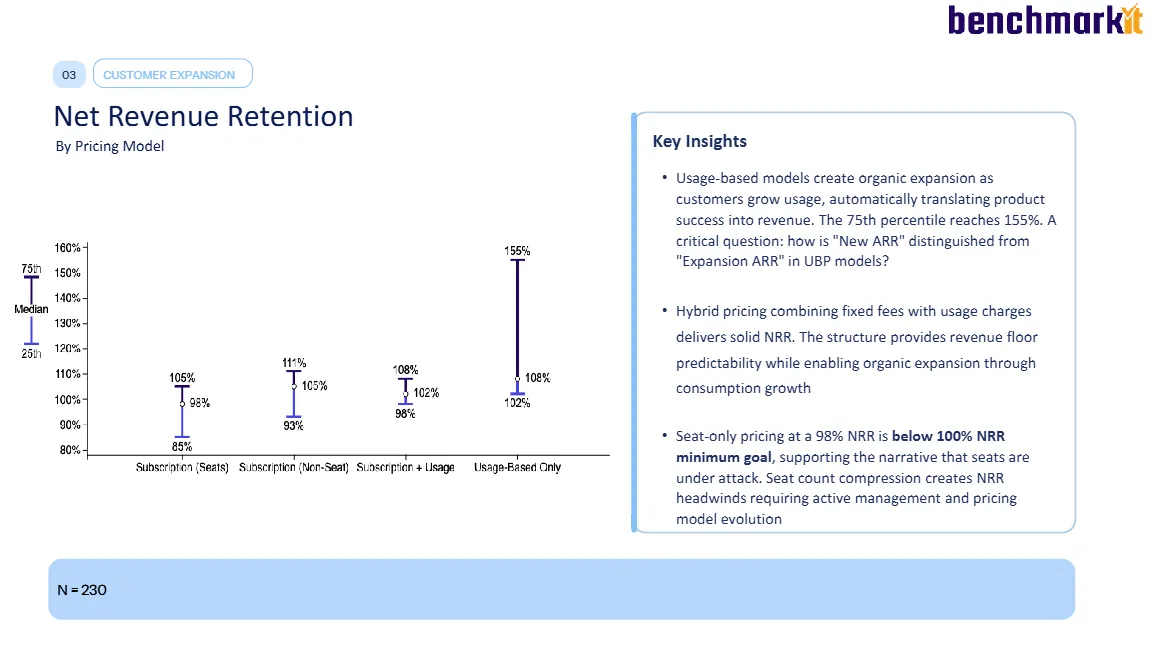
The gap compounds. On a $100,000 cohort, a 108% median gives $125,971 after three years and a 98% median gives $94,119 (our calculation, 1.08 cubed and 0.98 cubed). Read this as a pattern, not a promise: the two groups are different companies, and Benchmarkit itself asks how new ARR is told apart from expansion ARR in usage models. Usage-only also has the widest spread, from a 25th percentile of 102% to a 75th percentile of 155%.
For context, SaaS Capital's September 2025 survey defines NRR as including upsells, cross-sells and price increases, so a seat price rise counts as expansion. Our guide to SaaS metrics shows how NRR, GRR and churn fit together.
Does the pricing model change gross margin?
Yes, and usage-only pricing pays for its retention in margin. Benchmarkit's median total gross margin was 62% for usage-only companies, against 76% for seat subscriptions, 77% for subscription plus usage and 84% for non-seat subscriptions (228 companies, calendar year 2025).
The report attributes the low usage-only margin to infrastructure and compute costs during the ramp, before economics of scale settle in. Benchmarkit's separate software gross margin chart finds hybrid companies doing best and suggests cost-plus pricing of the variable part as a possible reason. For you, the lesson is to price usage with a floor: a minimum commitment or a platform fee absorbs the cost of the customers who consume little.
Which model leads on Rule of 40 and ARR per employee?
Subscription plus usage leads on the Rule of 40, with a median of 25% and a 75th percentile of 43%, in a Benchmarkit sample of 110 companies. Non-seat subscriptions had the lowest median at 18%.
Usage-only companies lead on revenue per head, at a median of $291K of ARR per employee against $222K for seat subscriptions (96 companies). Benchmarkit warns that part of the gap may reflect how usage ARR is classified, so treat it as a direction rather than a target.
Why are seats under pressure from AI?
Seats charge for access, and AI agents do work without a login. When one agent does the job of three support seats, a seat price shrinks the customer's bill and the vendor's revenue together.
ICONIQ's State of AI report, based on about 300 executives at software companies building AI products, shows the response. Consumption-based pricing rose from 35% to 42% of respondents over six months to its Q2 2026 survey, outcome-based pricing from 18% to 23%, and companies now blend 1.7 pricing models on average (ICONIQ, State of AI, The Builder's Economy, July 2026).
Poyar sees the same shift in credits. AI credit models were used by 29% of his 230 respondents, and another 33% planned to add them within six to twelve months. Among companies above $50M of ARR, roughly one in two planned to introduce AI credits in 2026.
Yet pure usage pricing for AI stays a minority choice. Among the 156 Benchmarkit companies that charge for AI, 39% use subscription plus usage, 26% seat-only subscriptions, 23% non-seat subscriptions and only 13% usage only. Benchmarkit points to concerns about revenue predictability and buyer resistance to open-ended costs.
How do vendors price AI on top of seats?
Most of them keep the seat and add a metered line for the AI. Three public pricing pages show the pattern, and each uses a different unit.
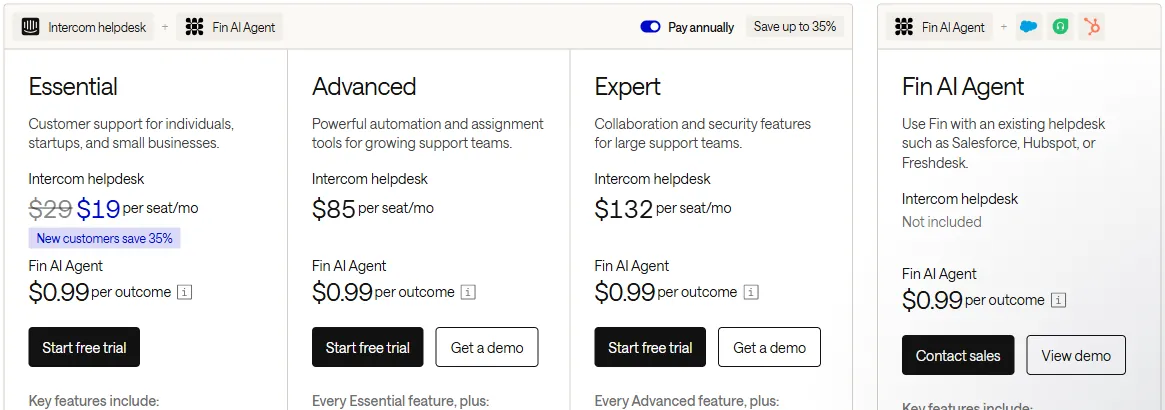
Intercom charges per seat for its helpdesk and $0.99 per outcome for its Fin AI Agent. Essential costs $29 per seat per month, or $19 for new customers, Advanced $85 and Expert $132, billed annually (Intercom pricing, consulted on 3 November 2026). Intercom's outcome rule is narrow. It bills at most once per conversation and refunds the charge if the conversation reopens. Fin costs nothing when it cannot answer or the customer asks for a human.
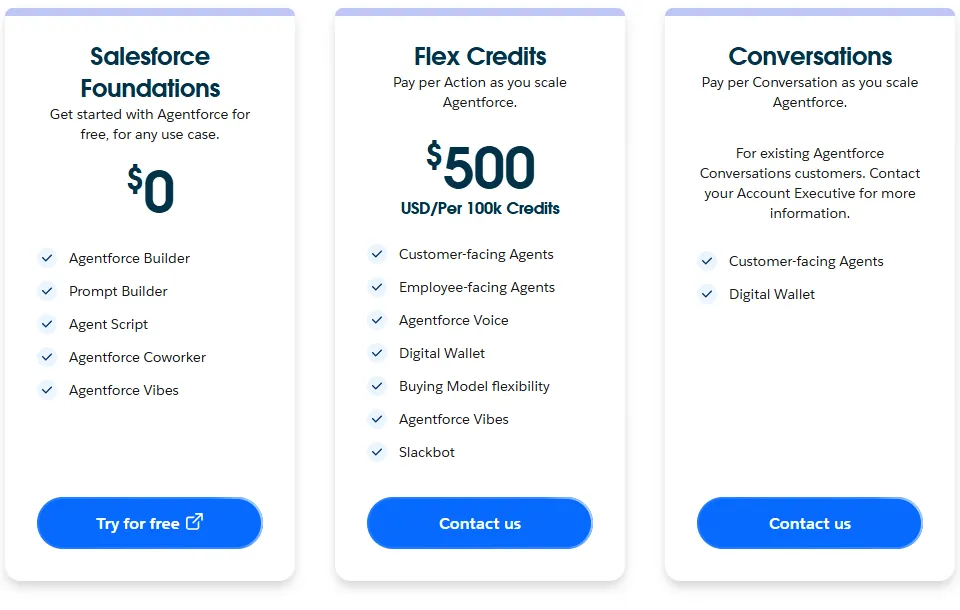
Salesforce lists several routes for Agentforce on one page. Flex Credits cost $500 per 100,000 credits, a standard Agentforce action uses 20 credits, an Agentforce add-on costs $125 per user per month for unmetered employee use, and a user license costs $5 per user per month before credits (Salesforce, Agentforce pricing, consulted on 3 November 2026).
Zendesk bills its AI agents per automated resolution, and its page states that a customer pays only for requests the agent resolves without escalation (Zendesk pricing, consulted on 3 November 2026).
What does hybrid pricing cost in practice?
The meter can outweigh the seats quickly. A 10-agent team on Intercom Essential pays 10 × $29 = $290 a month for seats. If Fin resolves 1,000 conversations in the month, 1,000 × $0.99 adds $990, for $1,280 in total (our calculation from Intercom's published prices). The AI line is 77% of the bill.
Salesforce's two employee options cross at a computable point. One action costs 20 × $500 / 100,000 = $0.10, so the $125 unmetered add-on beats metered credits for a user above 1,250 actions a month ($125 / $0.10, our calculation). A light user is cheaper on credits, and a heavy one on the add-on.
How do you choose a SaaS pricing model?
Choose the model that grows with the value your customer receives, then check that you can forecast it and that your margin survives it. Five steps cover most cases.
- Name the value unit. List what your customer would say they get: seats, projects, conversations resolved, events processed. Pick the unit that rises when their success rises.
- Check whether the unit is measurable. If you cannot count it without a dispute, an outcome price will cause arguments. Intercom's one-outcome-per-conversation rule is a model of how precisely this has to be written.
- Compute margin at the 90th percentile of usage. Poyar writes that the top 10% of power users drive more than 70% of token consumption in his experience, so cap or price that tail first.
- Keep a floor. A platform fee or a minimum commitment gives you forecastable revenue, which pure usage pricing makes harder.
- Offer a choice only if you can support it. 29% of Poyar's respondents let customers pick between pricing models, and Salesforce runs four. Each option adds billing and sales complexity.
For weak expansion revenue, Poyar suggests a premium edition priced 50% to 100% above the base edition. Paid add-ons that only some customers value and consumption limits for the heaviest AI users also work.
What mistakes do SaaS companies make when they change prices?
Most pricing mistakes come from changing the model without changing the way you measure it. Watch for these before a launch.
- Switching to usage pricing without a minimum commitment, then watching revenue swing from month to month.
- Reading NRR across models without separating new ARR from expansion ARR.
- Pricing AI at SaaS margins. Poyar's respondents had a median target AI gross margin of about 50%, and only 12% aimed for 80% or more.
- Moving the whole base at once. Vertice measured average SaaS price increases of 14.3% in early September 2026, so customers already expect scrutiny at renewal.
- Ignoring support load. A new model brings billing questions, and our comparison of help desk software for B2B SaaS prices the tools that handle them.
Where to start
Pull the last four quarters of revenue by customer and compute NRR and gross margin for your top and bottom usage deciles. If the heaviest users are your least profitable customers, add a floor or a limit before you change anything else. For the efficiency side of the same decision, our guide to CAC payback period shows how price changes move the payback months.
Frequently asked questions
What is the most common SaaS pricing model in 2026?
Hybrid pricing, which mixes a subscription with usage or outcome charges. Kyle Poyar's survey of 230 software companies, run in April and May 2026, found 37% on a hybrid model. Benchmarkit's benchmark of 342 companies counts 38.6% on seat subscriptions and 28.1% on subscription plus usage, because its categories and sample differ.
Is seat-based pricing dying?
Not yet, but it is under pressure. Seat-only companies had a median NRR of 98% in Benchmarkit's 2025 data, below the 100% line, and only 5% of Poyar's respondents said investors prefer seat pricing. Companies above $150M of ARR still use it most, at 29%.
What is the difference between usage-based and outcome-based pricing?
Usage-based pricing charges for a unit of consumption such as an API call, a credit or an action. Outcome-based pricing charges only when a defined result happens, such as Intercom's $0.99 for each conversation Fin resolves. Outcome pricing needs a result that is measurable and attributable, so it is harder to run.
Does usage-based pricing hurt gross margin?
In Benchmarkit's data it does. Usage-only companies had a median total gross margin of 62% in 2025, against 84% for non-seat subscriptions and 76% for seat subscriptions. Compute costs scale with usage, so the margin depends on how well you price the heaviest users.
How should a startup with few customers price its product?
Start with a flat fee or a simple per-seat plan. Poyar found that 37% of companies under $5M of ARR use flat fees, because they have too little usage history to set a unit price. Add a usage component once you can see which customers consume the most.
How often do SaaS companies change their pricing?
Often. Three in four software companies in Poyar's 2026 survey changed pricing or packaging in the previous year. Vertice, a procurement software vendor, measured average SaaS price increases of 14.3% in early September 2026.
Sources
- 01Benchmarkit, 2026 SaaS and AI Metrics Benchmarks (June 2026)
- 02Kyle Poyar, Growth Unhinged, The state of B2B monetization in 2026 (13 May 2026)
- 03ICONIQ, State of AI, The Builder's Economy (July 2026)
- 04Salesforce, Agentforce pricing (page consulted on 3 November 2026)
- 05Intercom, pricing (page consulted on 3 November 2026)
- 06Zendesk, pricing (page consulted on 3 November 2026)
- 07Vertice, SaaS inflation rate (October 2026)
- 08SaaS Capital, What is a good retention rate for a private SaaS company in 2025 (September 2025)