CAC payback period in 2026, formula, worked examples and benchmarks
How many months a new customer takes to repay its acquisition cost, how to calculate it without flattering the result, and where private and public SaaS companies stand in 2026.

CAC payback period is the number of months a new customer takes to repay its acquisition cost out of gross profit. The median private B2B SaaS company needed 16 months in 2025, and public software companies needed 31, so a payback under 12 months puts you well ahead of both groups.
Two sources frame the rest of this guide. Benchmarkit's 2026 report, published on 1 June 2026, surveyed 342 B2B SaaS and AI-native companies, and 198 of them reported CAC payback. Clouded Judgement, the weekly newsletter of Jamin Ball, who works at the investment firm Altimeter, tracks the same metric for listed software companies from their filings.
Key figures 2026
| Indicator | Value | Scope | Period | Source |
|---|---|---|---|---|
| Median CAC payback, private B2B SaaS | 16 months | 198 companies | CY 2025 | Benchmarkit, June 2026 |
| Same median a year earlier | 18 months | 198 companies | CY 2024 | Benchmarkit, June 2026 |
| 25th and 75th percentile | 10 and 24 months | 198 companies | CY 2025 | Benchmarkit, June 2026 |
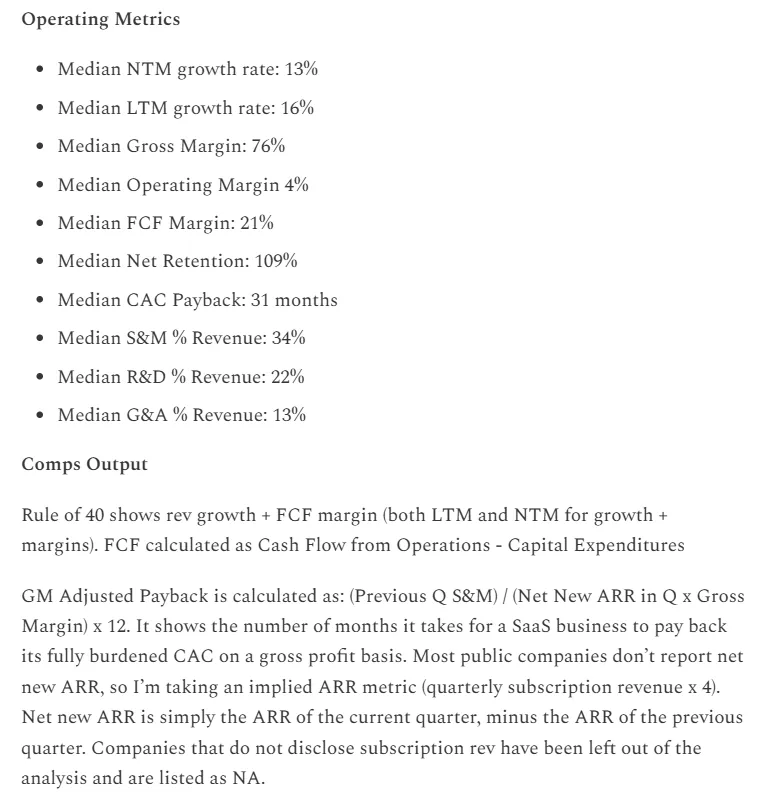
| Median CAC payback, public software | 31 months | Listed software companies | Edition of 30 Oct. 2026 | Clouded Judgement, Oct. 2026 |
| Median sales and marketing, public software | 34% of revenue | Listed software companies | Edition of 30 Oct. 2026 | Clouded Judgement, Oct. 2026 |
| Median SaaS magic number, private | 1.37 | 132 companies | CY 2025 | Benchmarkit, June 2026 |
| Median sales spend, private | 15% of ARR | 1,000+ companies | Survey closed March 2026 | SaaS Capital, June 2026 |
| Target CAC payback, SMB / mid-market / enterprise | Under 12 / 18 / 24 months | Bessemer guidance for cloud companies | 2021 guidance | Bessemer, Sept. 2021 |
What is the CAC payback period?
The CAC payback period measures how long the money spent to win a customer stays out before that customer's gross profit brings it back. Bessemer calls it its primary metric for sales and marketing efficiency, because "it is only after you repay CAC that you are generating profit on that customer" (Bessemer, Scaling to $100 Million, September 2021).
The metric answers a cash question that LTV to CAC cannot. LTV depends on a churn rate you may have measured over a few months, while payback only needs what you spent, what you sold and your gross margin. That makes it a useful first efficiency check for a seed or Series A company. Our guide to SaaS metrics shows how it sits next to churn, NRR and LTV.
How do you calculate CAC payback?
CAC payback equals acquisition cost divided by the monthly gross profit of the revenue that cost bought. You can compute it per customer or for a whole quarter, and both versions should land close to each other.
The per-customer CAC payback formula
The per-customer version is CAC / (new customer MRR × gross margin). It suits companies with a handful of deals a month and a stable price.
- Add the quarter's sales and marketing costs, salaries and commissions included, then divide by the customers won. Say $480,000 for 40 customers, a CAC of $12,000.
- Take the average new customer's MRR. An annual contract of $9,600 gives $800 a month.
- Multiply by gross margin. At 80%, each customer brings $640 of gross profit a month.
- Divide. $12,000 / $640 gives a payback of 18.75 months.
The company-level formula investors use
The quarterly version is (previous quarter sales and marketing) / (net new ARR in the quarter × gross margin) × 12. Clouded Judgement uses it to compare listed companies, and estimates ARR as quarterly subscription revenue times four because most of them do not publish net new ARR (Clouded Judgement, 30 October 2026).
With the same company, $480,000 of spend in the first quarter and $384,000 of new ARR in the second quarter at an 80% margin give 480,000 / 307,200 × 12, or 18.75 months again. Lagging spend by one quarter matters when sales cycles last a few months, because this quarter's deals were mostly paid for by last quarter's pipeline.
Which costs belong in CAC?
CAC covers every sales and marketing cost, not only ad spend. Bessemer's definition includes sales, marketing and the part of customer success tied to renewals, upsell and cross-sell, and it measures payback against gross margin adjusted ARR (Bessemer, September 2021).
For scale, private B2B SaaS companies spent a median of 15% of ARR on sales, up from 13% a year earlier, and 8% on marketing, in SaaS Capital's 15th annual survey of more than 1,000 companies, closed in March 2026 (SaaS Capital, spending benchmarks, June 2026). The same survey found that equity-backed companies spend 70% more on sales and 100% more on marketing than bootstrapped ones, which pushes their CAC up before any efficiency question.
Why gross margin changes the answer
Dividing by revenue instead of gross profit is the most common way to flatter payback. A customer paying $800 a month at an 80% margin returns $640, so the honest payback of 18.75 months becomes 15 months if you skip the margin, a fifth shorter. At the 76% median gross margin of listed software companies in Clouded Judgement's 30 October 2026 data, the gap grows to almost a quarter.
AI features make this worse in 2026. Model inference is a cost of revenue, so a product that adds usage-heavy AI can see its margin, and therefore its payback, slip even when price and CAC stay flat. Benchmarkit still measured an 80% median software gross margin in its June 2026 report, stable over four years.
What is a good CAC payback period in 2026?
A good CAC payback period is under 12 months for SMB customers, under 18 for mid-market and under 24 for enterprise, according to Bessemer. Against those targets, the median private B2B SaaS company at 16 months in 2025 sits in mid-market territory.
Benchmarkit's distribution is wide. The 25th percentile recovered CAC in 10 months and the 75th percentile in 24 months, with values running from 2 to 48 months across the 198 companies that answered (Benchmarkit, 2026 SaaS and AI Metrics Benchmarks, June 2026). Investor David Skok writes that many of the best SaaS businesses recover CAC in 5 to 7 months and that profitability is weak beyond 12 (SaaS Metrics 2.0).
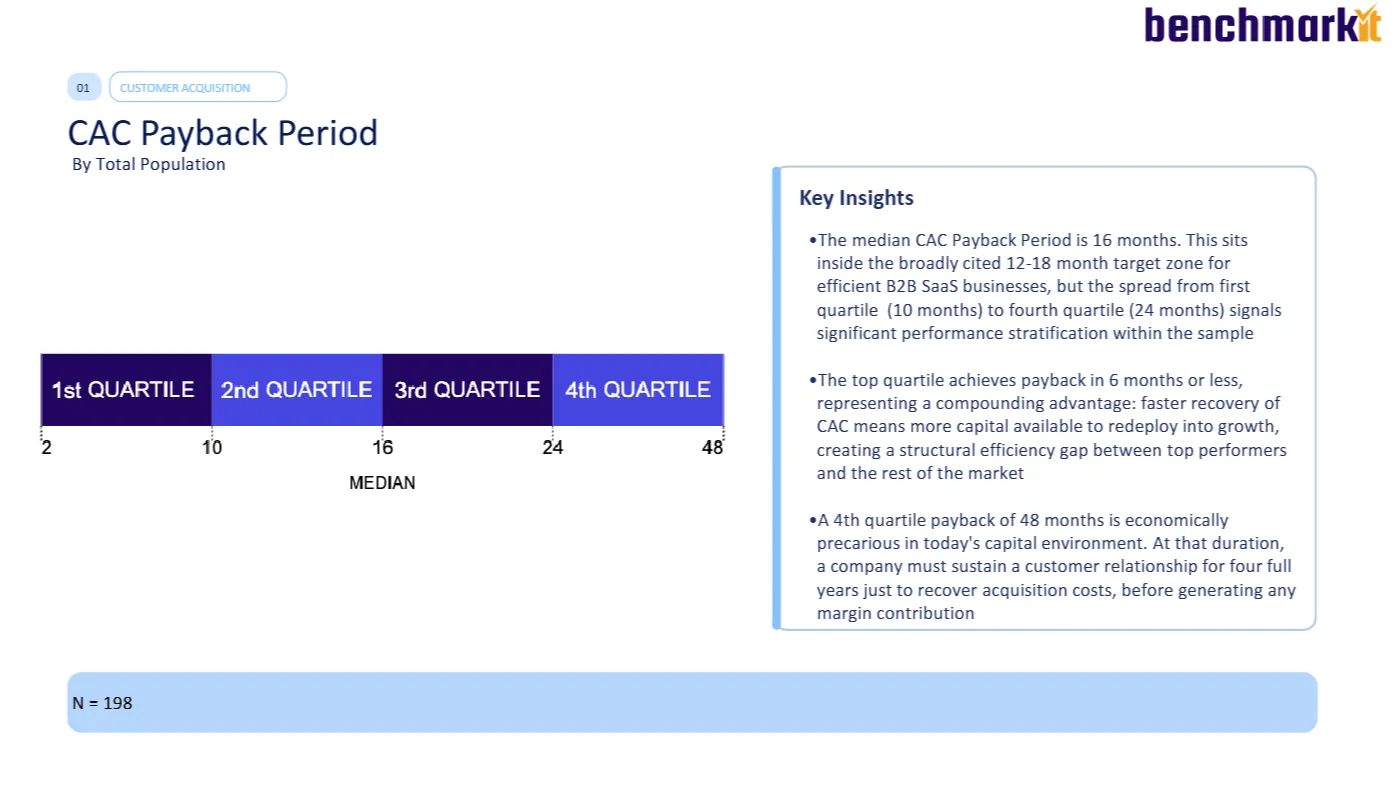
The trend is not a straight line. Benchmarkit's median was 16 months in 2022, 14 months in 2023, 18 months in 2024 and 16 months in 2025, and the report links the 2024 jump to spending made to find growth. Its 25th percentile improved from 12 months in 2024 to 10 months in 2025.
How does CAC payback vary with contract value?
Contract value is the biggest driver of payback, because larger deals need field sales, longer cycles and procurement. Benchmarkit's medians by average contract value for 2025 rise from 11 months under $5,000 to 22 months between $50,000 and $100,000.
| Average contract value | Median CAC payback | 25th percentile | 75th percentile |
|---|---|---|---|
| Under $5,000 | 11 months | 10 | 17 |
| $5,000 to $10,000 | 12 months | 8 | 20 |
| $10,000 to $25,000 | 18 months | 10 | 34 |
| $25,000 to $50,000 | 17 months | 13 | 24 |
| $50,000 to $100,000 | 22 months | 15 | 27 |
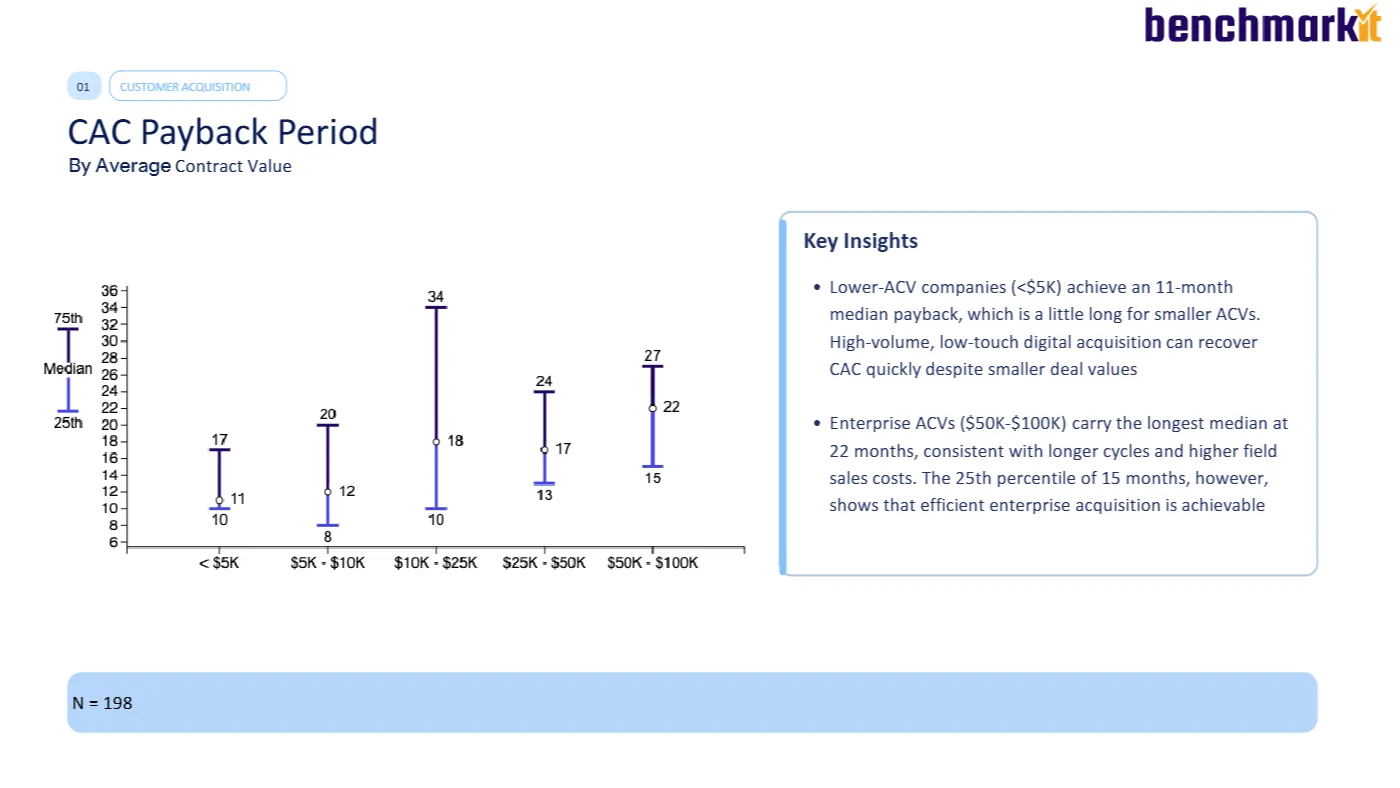
The $10,000 to $25,000 band has the widest spread, from 10 to 34 months. That is the zone where companies often move from inside sales to account executives with longer cycles, and where a sales hire made too early shows up in payback within two quarters.
Do fast-growing SaaS companies have shorter payback?
Yes, in the 2025 data. Companies growing more than 50% had a median CAC payback of 10 months, against 18 months for those growing 11% to 20% and 22 months for those growing 21% to 30%, according to Benchmarkit's survey of 198 companies.
The 21% to 30% group is the outlier, and Benchmarkit reads it as companies spending ahead of growth that has not arrived yet. Companies growing under 10% had a median of 14 months, which suggests tight cost control more than strong demand. Vertical SaaS companies needed 18 months against 14 months for horizontal products in the same survey.
Why do public SaaS companies take 31 months?
Listed software companies had a median CAC payback of 31 months in Clouded Judgement's 30 October 2026 edition, almost twice the private median. The same data shows median sales and marketing spend at 34% of revenue, median revenue growth of 16% over the last twelve months and median net retention of 109%.
Three things explain most of the gap. Public companies sell larger contracts to larger buyers, so their payback looks like Benchmarkit's enterprise bands. Clouded Judgement's formula uses net new ARR, which nets out churn and downgrades, while private surveys often use new customer ARR. And a 109% net retention means a public company's customers keep paying, and usually paying more, for years after payback, so a long payback costs it less than it would cost a startup.
How do CAC payback, the CAC ratio and the magic number compare?
The three metrics read the same cost line from different angles. The CAC ratio is sales and marketing spend per dollar of new ARR, the magic number is new ARR per dollar of spend, and payback turns either one into months of gross profit.
| Metric | Formula | Private median, 2025 | Prior year | Source |
|---|---|---|---|---|
| CAC payback | S&M / (new ARR × gross margin) × 12 | 16 months (n = 198) | 18 months | Benchmarkit |
| Blended CAC ratio | S&M / new and expansion ARR | $1.30 (n = 122) | $1.40 | Benchmarkit |
| New customer CAC ratio | S&M / new customer ARR | $1.63 (n = 128) | $2.00 | Benchmarkit |
| SaaS magic number | Quarterly new ARR / prior quarter S&M | 1.37 (n = 132) | 0.94 | Benchmarkit |
| LTV to CAC | Lifetime gross profit / CAC | 4.1x (n = 146) | 3.6x to 3.7x in 2022 to 2024 | Benchmarkit |
The conversion is simple. Payback in months equals the CAC ratio × 12 / gross margin, so Benchmarkit's median new customer CAC ratio of $1.63 at its 80% median margin works out to 24.5 months (our calculation, 1.63 × 12 / 0.8). That is longer than the reported 16-month median, because each metric comes from a different subset of respondents and the medians of different samples do not combine. Use the formula on your own numbers, not on someone else's medians.
The formulas in the table are the usual definitions, consistent with how Benchmarkit describes its ratios. Benchmarkit's summary of the 2026 benchmarks puts the magic number above 1.0, and the full report shows it rising from 0.94 in 2024 to 1.37 in 2025, the first time above 1.0 in its four-year series. Its 25th percentile sat at 0.68, below the 0.75 to 1.0 range the report treats as the minimum that justifies more go-to-market spending.
How does CAC payback affect cash and burn?
Every month of payback is a month of working capital tied up in each new customer. A company adding $384,000 of new ARR a quarter at an 18.75-month payback has spent $480,000 before the first of those customers is profitable, and it spends again the next quarter.
That is why payback and burn move together. ICONIQ's 2026 State of Scaling, built on quarterly data from 137 software companies and published in September 2026, found that its Pacesetters, AI-native or AI-driven companies with top-quartile growth, ran a median burn multiple of 0.8x in 2026 once above $100 million of ARR, against 1.4x for other companies at that scale (ICONIQ, 2026 State of Scaling). A shorter payback is one of the few ways to grow faster without raising the burn multiple.
Sales capacity has its own payback. The KeyBanc Capital Markets and Sapphire Ventures 2025 survey expects account executive payback periods to shorten to 18 months by 2026 (KeyBanc and Sapphire Ventures, 2025 SaaS Survey, November 2025). That metric measures how fast a new sales hire covers their cost, not a customer, so do not mix it with CAC payback in a board deck.
How can you shorten your CAC payback period?
You shorten payback by raising the gross profit each new customer brings or by lowering what it costs to win them. Price and channel mix usually move it faster than sales process changes.
- Raise the entry price or the first-year contract value. Payback falls in proportion. Moving the example customer from $800 to $1,000 of MRR cuts payback from 18.75 to 15 months with the same CAC.
- Fund the channels with the lowest CAC. Tag every deal with its source in the CRM and compute payback per channel. Our CRM comparison for startups covers how to set up lead source fields properly.
- Add a self-serve or hybrid motion. Benchmarkit found a median blended CAC ratio of $0.86 for hybrid product-led and sales-led companies, against $1.30 for the whole sample.
- Invest in inbound demand. Benchmarkit links the lower new customer CAC ratio of its high-growth companies, $1.40 against $1.85 for companies growing 11% to 20%, to brand investment and answer engine optimization. Our comparison of GEO tools for SaaS covers how to track whether ChatGPT and Perplexity recommend you.
- Protect gross margin. Price AI features so inference costs do not erode the margin that repays CAC.
What mistakes distort CAC payback?
Most bad payback figures come from leaving costs out or counting revenue that is not new. Check these before you share the number.
- Counting only ad spend and leaving out salaries, commissions, tools and agencies.
- Dividing by revenue instead of gross profit.
- Mixing expansion ARR into the denominator while leaving customer success costs out of the numerator.
- Matching a month of spend with the same month's deals when sales cycles last a quarter.
- Calling annual prepayment a shorter payback. It shortens cash recovery, not the metric.
- Comparing your figure with a public company median built on net new ARR.
Where to start
Compute your payback for the last four quarters with the company-level formula, lag spend by one quarter, and split it by contract size so you can compare each band with Benchmarkit's table above. If one band sits far above its benchmark, start there. For the metrics that sit around payback, including churn, NRR and LTV to CAC, our SaaS metrics guide has formulas and a worked example for each.
Frequently asked questions
What is a good CAC payback period for a SaaS startup?
Under 12 months is strong for a company selling to small businesses, and 12 to 18 months is normal for mid-market. Benchmarkit's 2026 report puts the median private B2B SaaS company at 16 months and the best quarter at 10 months or less. Enterprise sellers can carry 24 months if their customers renew for years.
Is CAC payback calculated on revenue or gross profit?
On gross profit. Hosting, support and payment fees come out of every dollar a customer pays, so only the gross margin share repays acquisition cost. Bessemer and Clouded Judgement both adjust for gross margin, and skipping it shortens payback by a fifth or more at a typical 76% to 80% margin.
Should customer success costs count in CAC?
Count the part of customer success that wins renewals and upsells if your new ARR includes expansion. Bessemer's definition includes sales, marketing and that share of customer success. If you measure payback on new logos only, keep customer success out and say so next to the figure.
Does annual prepayment shorten CAC payback?
It shortens cash payback, not CAC payback. A customer paying a year upfront returns the cash at signature, which helps runway, but the metric still divides cost by monthly gross profit. Track both and label them, because investors read CAC payback as an efficiency measure.
How often should you measure CAC payback?
Quarterly, on a trailing basis. A single month swings with hiring waves and large deals, while a quarter of spend matched with the next quarter's new ARR evens out sales cycle timing. Early-stage companies with few deals can use a trailing six or twelve months.
What is the difference between CAC payback and the CAC ratio?
The CAC ratio is sales and marketing spend per dollar of new ARR, and payback converts it into months of gross profit. Payback equals the CAC ratio times 12 divided by gross margin. A CAC ratio of 1.0 at an 80% margin means 15 months of payback.
Sources
- 01Benchmarkit, 2026 SaaS and AI Metrics Benchmarks report (June 2026)
- 02Benchmarkit, 2026 B2B SaaS and AI-Native Metrics, interactive benchmarks (2026)
- 03Jamin Ball, Clouded Judgement 10.30.26 (October 2026)
- 04SaaS Capital, spending benchmarks for private B2B SaaS companies (June 2026)
- 05Bessemer Venture Partners, Scaling to $100 Million (September 2021)
- 06David Skok, SaaS Metrics 2.0
- 07KeyBanc Capital Markets and Sapphire Ventures, 2025 SaaS Survey (November 2025)
- 08ICONIQ, 2026 State of Scaling, The Great Sorting (September 2026)