Best help desk software for B2B SaaS in 2026, 8 tools compared
Eight help desks compared for B2B SaaS support teams, with seat prices and AI agent rates checked on each vendor's site on 30 October 2026.

The best help desk software for a B2B SaaS company in 2026 is Intercom if you support users inside your product, Zendesk if you run high ticket volumes with formal SLAs, and Pylon if customers expect answers in Slack. Freshdesk, Help Scout, Plain, Front and Crisp fit narrower needs or tighter budgets.
We compared eight help desks against what a SaaS support team of 3 to 20 agents needs. Every price below comes from the vendor's own pricing page, checked on 30 October 2026, in the currency the vendor shows. We did not run hands-on tests. The ranking rests on published plans and documentation.
Key figures 2026 for SaaS customer support
Support budgets are nearly flat while AI spending climbs, and customers still want a person within reach.
| Indicator | Value | Scope | Period | Source |
|---|---|---|---|---|
| Growth in AI spending by customer service leaders | 38% | 199 service and support leaders | April to May 2026 | Gartner, August 2026 |
| Growth in overall service and support budgets | 2% | Same survey | April to May 2026 | Gartner, August 2026 |
| Customers who say a company using GenAI must offer a human agent | 87% | 3,566 B2B and B2C customers | February to March 2026 | Gartner, August 2026 |
| B2B customers using GenAI who have had it complete a task for them | 74% | GenAI users in the same survey | February to March 2026 | Gartner, July 2026 |
| Service leaders with a positive financial return on AI | 24% | Service leaders among 1,303 senior leaders | January to April 2026 | Gartner, July 2026 |
| Leaders who reduced agent staffing because of AI | 20% | 321 service and support leaders | October 2025 | Gartner, December 2025 |
| Median spend on customer support and success | 9% of ARR | More than 1,000 private B2B SaaS companies | Survey completed March 2026 | SaaS Capital, June 2026 |
| Same, for companies at $3 million to $5 million ARR | 10% of ARR | Same survey | March 2026 | SaaS Capital, June 2026 |
Which help desk software is best for B2B SaaS?
Intercom ranks first for B2B SaaS because it pairs an in-app messenger with an AI agent whose price is public. The table sums up the eight tools, and the cards below go into prices and limits.
| Help desk | Free plan or trial | Entry paid price | AI agent pricing | Best for |
|---|---|---|---|---|
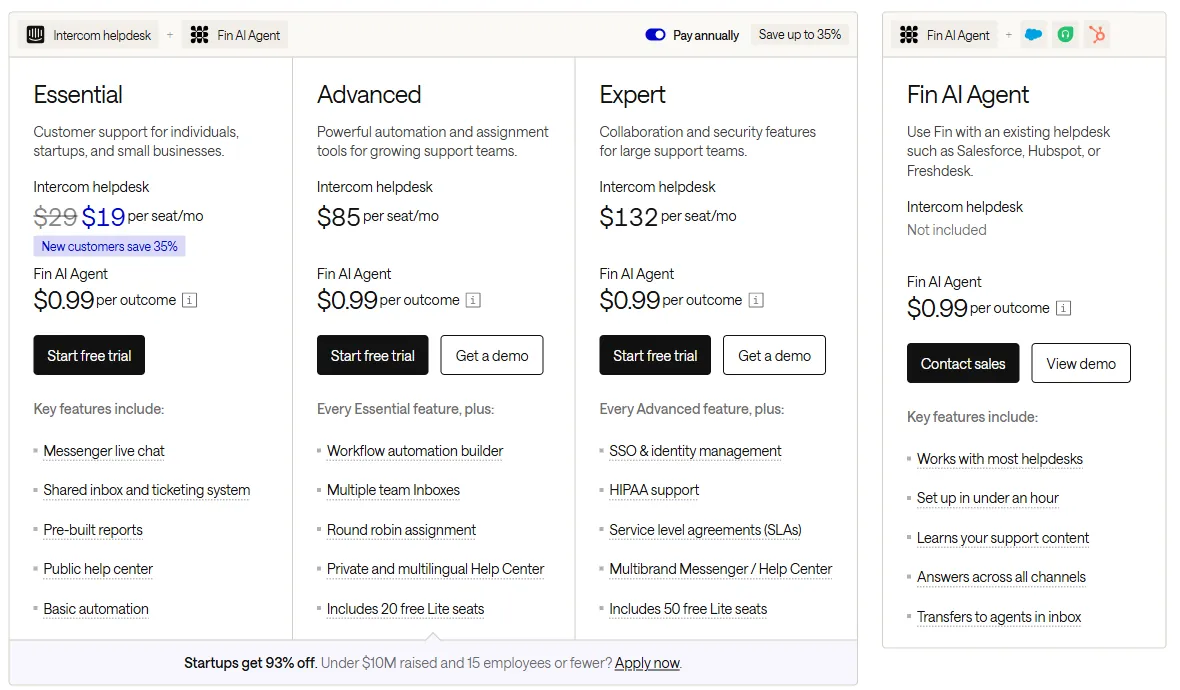
| Intercom | 14-day trial | $29 per seat billed annually ($19 for new customers) | $0.99 per outcome | In-app support with AI |
| Zendesk | 14-day trial, 6-month startup program | $19 per agent (Support Team), $55 (Suite Team), billed annually | $1.50 per automated resolution committed, $2.00 pay as you go | High volume and SLAs |
| Pylon | Trial set up by sales | $89 per seat, annual contract | $0.30 per credit pay as you go, from $0.24 committed | Slack Connect and Teams |
| Freshdesk | 14-day trial | $19 per agent billed annually | 500 sessions once, then $49 per 100 | Low-cost ticketing |
| Help Scout | Free for 5 users | $25 per user billed annually | $0.75 per resolution | Small email-first teams |
| Plain | 7-day trial | $45 per user billed annually | 100 credits per resolution, $10 per 1,000 credits | API-first B2B support |
| Front | 14-day trial | $25 per seat billed annually | Autopilot from $0.05 per conversation | Shared inboxes with account teams |
| Crisp | Free for 2 seats | $45 a month per workspace, 4 seats | Credits included in each plan | Flat budget, early stage |
- 01
Intercom
Best forSaaS products that support users in the app and want an AI agent with a public price
PriceEssential $29 per seat per month billed annually ($19 for new customers), Advanced $85, Expert $132, plus Fin AI Agent at $0.99 per outcome (checked on October 30, 2026)
Strengths
- In-app Messenger and ticketing on every plan
- Fin AI Agent billed at $0.99 per outcome, at most once per conversation and refunded if the conversation reopens
- Startups with under $10M raised and 15 employees or fewer can apply for up to 93% off
- 14-day trial with no credit card
Limits
- SLAs are only on Expert, at $132 per seat per month billed annually
- The workflow automation builder starts on Advanced at $85 per seat
- Copilot costs $29 per agent per month billed annually ($35 monthly) past 10 free conversations
The default for a B2B SaaS team whose questions start inside the product. Budget for Advanced rather than Essential if you need workflows, and price Fin on last month's real conversation volume before you sign.
Visit site Intercom - 02
Zendesk
Best forSupport teams with high ticket volume, several channels and formal SLAs
PriceSupport Team $19, Suite Team $55, Suite Professional $115 per agent per month billed annually, Enterprise on quote (checked on October 30, 2026)
Strengths
- AI agents for messaging and email on every plan, with 5 automated resolutions per agent per month included (10 on Suite Professional)
- SLA policies on Suite Professional and Enterprise
- Startup program with a 6-month Zendesk Suite trial for up to 50 agents
- 14-day trial of Suite Professional
Limits
- Automated resolutions beyond the allowance cost $1.50 each with a commitment or $2.00 pay as you go
- Copilot is an add-on at $50 per agent per month billed annually
- Full live chat and telephony start on Suite Team, not on Support Team
The safest choice once support runs on queues, SLAs and several channels. For a small team it is more system than you need, and at $2.00 per pay-as-you-go resolution its AI agent costs about twice Intercom's $0.99 per outcome.
Visit site Zendesk - 03
Pylon
Best forB2B companies whose customers ask for help in shared Slack, Teams or email channels
PriceProfessional $89, Advanced $139 per seat per month on an annual contract, Enterprise on quote, AI credits at $0.30 each pay as you go or from $0.24 committed (5,000-credit minimum) (checked on October 30, 2026)
Strengths
- Slack Connect, email, chat widget, WhatsApp and Discord in a single queue
- Microsoft Teams support and a customer portal on Advanced
- Account Intelligence add-on at $10 per customer account per month for health scores, from 50 accounts
- You pay for seats and AI credits, never per ticket
Limits
- A minimum seat count applies to new customers, and the number is not published
- No free plan, trials are set up with a sales rep
- AI usage is billed in credits on top of seats, and the credits a ticket uses vary with its complexity
The pick for a B2B SaaS company that already lives in shared Slack channels with its customers. It is the most expensive seat in this list, so it pays off when each account brings several people and real revenue.
Visit site Pylon - 04
Freshdesk
Best forTeams that want full ticketing at a low seat price
PriceGrowth $19, Pro $55, Enterprise $89 per agent per month billed annually, extra AI Agent sessions $49 per 100 (checked on October 30, 2026)
Strengths
- Ticketing, shared inbox, customer portal and knowledge base from Growth
- 500 Freddy AI Agent sessions included, once per account
- Multiple SLA policies and intelligent routing on Pro
- 14-day trial of the Enterprise plan
Limits
- No free plan is listed on the pricing page
- AI sessions beyond the first 500 cost $49 per 100
- Freddy AI Copilot is a paid add-on on Pro and Enterprise
The value pick for a ticket-driven team that wants Zendesk-style queues for about a third of Zendesk's Suite Team seat price. Check the session count you will really use, since the free AI allowance is a one-time pool.
Visit site Freshdesk - 05
Help Scout
Best forSmall support teams that want email-first support and a free start
PriceFree for 5 users, Standard $25, Plus $45, Pro $75 per user per month billed annually ($30, $54 and $90 monthly), AI Answers $0.75 per resolution (checked on October 30, 2026)
Strengths
- Free plan for 5 users and 1 inbox
- AI Answers at $0.75 per resolution, with 3 months of free unlimited resolutions at sign-up
- One basic SLA policy on Standard, two advanced ones on Plus
- 15-day trial of Standard and Plus, no credit card
Limits
- The free plan stops at 100 contacts a month
- Grouping conversations by company and the Salesforce, Jira and HubSpot integrations sit on Plus
- Pro requires at least 10 users
The easiest help desk to adopt for a team of two to ten people answering mostly by email. B2B teams should plan for Plus, where conversations group by company.
Visit site Help Scout - 06
Plain
Best forTechnical B2B teams that support customers in Slack and want an API-first help desk
PriceFoundation $45, Horizon $99 per user per month billed annually, extra AI credits $10 per 1,000 (checked on October 30, 2026)
Strengths
- Slack and in-app support with Linear and Jira integrations on Foundation
- 1,000 AI credits a month on Foundation and 2,500 on Horizon, with 100 credits per Customer Agent resolution
- Microsoft Teams and SLAs on Horizon
- 7-day trial with no card, and 50% off through the startup program
Limits
- Foundation allows up to 5 member seats and Horizon up to 10
- SLAs need Horizon
- Larger teams move to Frontier, priced on quote
A strong fit for a developer tools or infrastructure company whose support engineers work next to Linear and Jira. Teams above ten agents will be on a custom contract quickly.
Visit site Plain - 07
Front
Best forAccount managers and support staff sharing one inbox with B2B clients
PriceStarter $25 (up to 10 seats), Professional $65 (up to 50 seats), Enterprise $105 per seat per month billed annually (checked on October 30, 2026)
Strengths
- Shared inbox and ticketing on every plan
- Omnichannel and SSO from Professional
- Autopilot AI agent from $0.05 per conversation, Copilot at $20 per seat per month on Starter and Professional
- 14-day trial with Professional features, no card
Limits
- Starter covers a single channel type and up to 10 automation rules
- AI tools are paid add-ons below Enterprise
Best when the people answering customers are not only support agents but also account and success managers. Pure support teams get more ticketing depth from Zendesk or Freshdesk for a similar price.
Visit site Front - 08
Crisp
Best forEarly-stage teams that want chat, email and a knowledge base for one flat monthly price
PriceFree for 2 seats, Mini $45, Essentials $95, Plus $295 per workspace per month, VAT excluded (checked on October 30, 2026)
Strengths
- Flat price per workspace, with 10 seats included on Essentials
- Knowledge base and AI chatbot from Essentials
- AI credits included from Mini, worth about 90 automated conversations
- Built by a French company based in Nantes
Limits
- The ticketing system and customer portal are only on Plus
- Included AI credits are small, about 450 automated conversations on Essentials
- The free plan has no AI credits and 100 customer profiles
The cheapest way to give a seed-stage team live chat, a shared inbox and a help center. Teams that need queues and SLAs will move to Plus or to a ticket-first tool.
Visit site Crisp
How we compared these help desks
We ranked the tools on what a B2B SaaS support team needs between its first support hire and about 20 agents. Five questions carried the weight.
- B2B context. Can agents see the company behind a ticket, sync it with the CRM and answer in shared Slack or Teams channels?
- AI agent pricing. Is the rate public, and does the vendor bill a resolution, an outcome, a session or a conversation?
- Cost at five agents. We took the yearly list price on annual billing, then the jump to the tier most teams end up on.
- Core features. We checked the plan where SLA policies, the knowledge base, reporting and automation each start.
- Ways to start. Free plans and startup programs count, because a seed-stage team often runs support on the founders' time.
The order reflects a typical B2B SaaS company selling subscriptions to businesses, with most requests coming from the product or by email. If your support is mostly phone-based or consumer-facing, Zendesk moves up.
HubSpot Service Hub is missing on purpose. HubSpot's pricing pages showed two different price lists for the same plans during our check on 30 October 2026, so we left it out rather than publish a seat price we could not confirm. If HubSpot already runs your sales, read our CRM comparison for startups first, since tickets there sit on the same records as your deals.
How much does help desk software cost for 5 agents?
A five-agent support team pays between $1,140 and $5,340 a year at list price for an entry plan on annual billing, and up to $8,340 on the tier that adds SLAs or B2B channels. Each figure below is the published seat price times 5 agents times 12 months.
| Help desk | Entry plan, 5 agents a year | Upgrade most B2B teams need | Upgrade, 5 agents a year |
|---|---|---|---|
| Freshdesk | Growth, $1,140 | Pro, for multiple SLA policies | $3,300 |
| Crisp | Essentials, $1,140 (10 seats included) | Plus, for ticketing and a portal | $3,540 |
| Help Scout | Standard, $1,500 | Plus, for advanced SLAs and company grouping | $2,700 |
| Front | Starter, $1,500 | Professional, for omnichannel | $3,900 |
| Intercom | Essential, $1,740 ($1,140 at the new-customer price) | Advanced for workflows, Expert for SLAs | $5,100 to $7,920 |
| Plain | Foundation, $2,700 | Horizon, for SLAs and Teams | $5,940 |
| Zendesk | Suite Team, $3,300 | Suite Professional, for SLAs | $6,900 |
| Pylon | Professional, $5,340 | Advanced, for Teams and a portal | $8,340 |
The seat table hides two costs. The first is the AI assistant for agents: Intercom's Copilot is $29 per agent per month billed annually after 10 free conversations, and Zendesk's Copilot is $50 per agent per month billed annually. Front charges $20 per seat for Copilot on Starter and Professional.
The second is the AI agent that answers customers, billed by usage. Once volume grows, that line can overtake the seat bill.
What does an AI agent cost per resolution?
Published AI agent rates run from $0.05 per conversation at Front to $2.00 per pay-as-you-go automated resolution at Zendesk, and the billing unit matters as much as the rate. The table turns each published rate into a monthly bill for 1,000 conversations handled by AI.
| Help desk | Billable unit | Published rate | For 1,000 a month |
|---|---|---|---|
| Front | Conversation handled by Autopilot | From $0.05 | From $50 |
| Freshdesk | Session (72 hours from the first email, for email) | $49 per 100 after the first 500 | $490 |
| Help Scout | Conversation resolved without human help | $0.75 | $750 |
| Intercom | Outcome, at most one per conversation | $0.99 | $990 |
| Plain | Customer Agent resolution, 100 credits | $10 per 1,000 credits | $1,000 before included credits |
| Pylon | Credits, a median 5.3 per automated ticket in its calculator | $0.30 per credit pay as you go, $0.24 to $0.15 committed | $1,590 at the pay-as-you-go rate |
| Zendesk | Automated resolution, 5 to 10 included per agent per month | $1.50 committed, $2.00 pay as you go | $1,500 to $2,000 before included resolutions |
Compare units before rates. Intercom charges $0.99 per outcome, at most once per conversation, nothing when Fin cannot answer or the customer asks for a human, and it refunds the outcome if the conversation reopens. Help Scout bills $0.75 per resolution, counted when AI Answers resolves a conversation without human help. Freshdesk sells sessions at $49 per 100, and an email session covers 72 hours from the customer's first email, however many replies the AI sends. Front prices Autopilot from $0.05 per conversation. Vendors also publish their own success rates, which you should read as claims. Intercom says Fin averages 76% across more than 12,000 customers, and Help Scout's calculator states an average resolution rate of 73%. Both sell a tool in this ranking, so test the rate on your own tickets during the trial.
Zendesk lists its AI rates in the plan comparison table. Each agent seat includes 5 automated resolutions a month on Support Team and Suite Team and 10 on Suite Professional, then each resolution costs $1.50 with a commitment or $2.00 pay as you go. Pylon's credit calculator puts a median automated ticket at 5.3 credits, which is $1.59 at its $0.30 pay-as-you-go rate.
Intercom vs Zendesk vs Freshdesk, which one fits?
Intercom fits support that starts inside the product, while Zendesk and Freshdesk fit teams that think in queues and SLAs. Between those two, the gap is mostly price.
Intercom's Messenger sits in your app, so the user's account and plan travel with the question. Its weak spot for B2B is SLAs, which only appear on Expert at $132 per seat. Zendesk puts SLA policies on Suite Professional and Enterprise, at $115 per agent per month billed annually, and adds telephony and messaging from Suite Team.
Freshdesk covers a large part of Zendesk's ticketing for less. Growth costs $19 per agent per month on annual billing against $55 for Zendesk Suite Team, and multiple SLA policies come with Pro at $55. Freshworks, which sells Freshdesk, reported second-quarter 2026 revenue of $237.4 million, up 16% year on year, with 25,356 customers paying more than $5,000 in ARR. If you are looking at Zendesk alternatives mainly for price, start there.
When does a Slack-first help desk make sense?
A Slack-first help desk makes sense when your customers are companies that already share Slack Connect or Teams channels with you, and several people per account ask questions. Pylon and Plain are built for that pattern, while the email-first tools treat Slack as one channel among others.
Pylon brings Slack Connect, email, a chat widget, WhatsApp and Discord into one queue on its Professional plan at $89 per seat, and adds Microsoft Teams on Advanced at $139. Its Account Intelligence add-on, at $10 per customer account per month, adds health scores and account notebooks, which matters when support and customer success share the same accounts.
Plain covers Slack and in-app chat on Foundation at $45 per user, with Teams and SLAs on Horizon at $99. Both bill AI through credits. Help Scout takes a lighter route with company grouping on Plus, which suits B2B teams whose clients still write mostly by email.
How much should a SaaS company spend on customer support?
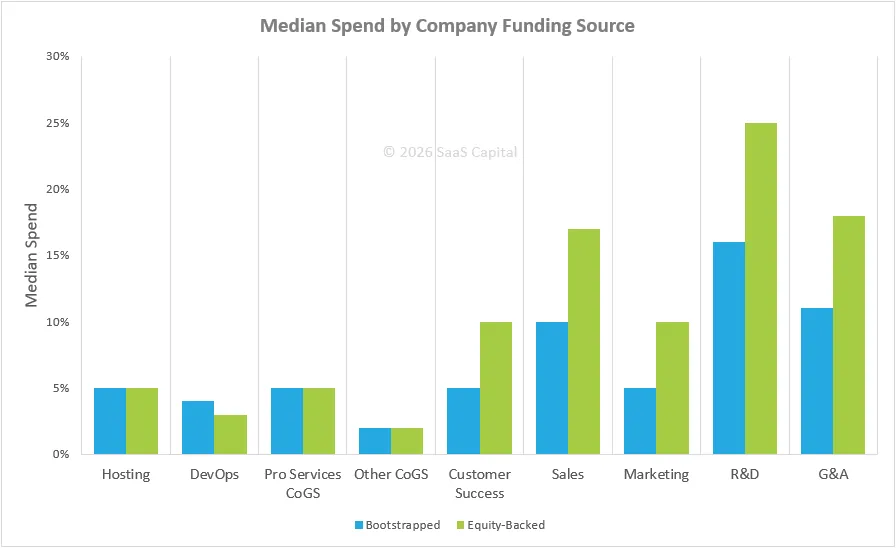
Private B2B SaaS companies spent a median 9% of their annual recurring revenue on customer support and customer success in 2026, up from 8% the year before, according to SaaS Capital's 15th annual survey of more than 1,000 private companies, completed in March 2026 and published in June 2026. Companies with $3 million to $5 million of ARR reported a median of 10%. The same survey found that equity-backed companies spend 100% more on customer success than bootstrapped ones. Put in dollars, a company at $4 million of ARR spending 10% puts $400,000 a year into support and success, and five Zendesk Suite Professional seats at $6,900 a year are 1.7% of that, a calculation from SaaS Capital's median and Zendesk's list price. The license is rarely the expensive part of support. People are, and the AI usage that takes over part of their work.
That budget should show up in retention. Gross revenue retention tells you how much revenue survives cancellations, and our SaaS metrics guide explains how to calculate it with churn and NRR.
Will AI agents replace your support team?
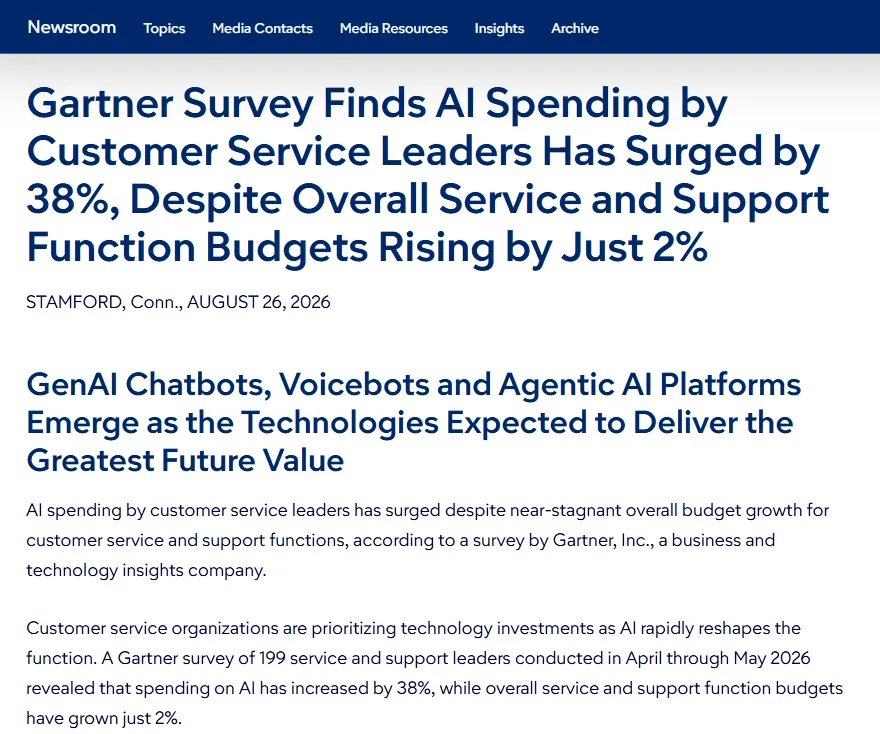
AI agents are not replacing most support teams yet, and the data shows leaders adding roles rather than cutting them. In a Gartner survey of 321 customer service and support leaders conducted in October 2025 and published in December 2025, only 20% had reduced agent staffing because of AI. Another 55% kept staffing stable while handling higher volumes, and 42% were hiring for new AI-focused roles. Gartner also forecasts that by 2027, half of the organizations expecting major AI-driven workforce cuts will drop those plans. The money is moving anyway. A separate Gartner survey of 199 service leaders, run from April to May 2026, found AI spending up 38% while total service budgets rose 2%. For a SaaS support lead, the practical goal is fewer repetitive tickets per agent, not fewer agents.
Returns are uneven. In a Gartner survey of 1,303 senior leaders run from January to April 2026, service and support leaders had invested a median 12% of their 2025 budget in AI, the highest of the 10 functions assessed, yet only 24% showed a positive financial return across their AI use cases. Part of the reason sits outside the help desk. In Gartner's customer survey, people were about three times more likely to use third-party GenAI such as ChatGPT than a company chatbot during their latest service interaction.
Customers also set a limit. In Gartner's survey of 3,566 B2B and B2C customers, 87% said a company using GenAI for service must offer a way to reach a human agent. Pick a help desk where the handover from AI to a person is one click, and keep it visible.
What should you check before switching help desk?
Check two things on your own data before you sign: the plan where your must-have features start, and what the AI agent will really cost. The steps below take about a week with a free trial.
- Export last month's conversations and count them by channel, including Slack threads and in-app chat.
- Multiply that volume by each vendor's AI unit price, using the share of questions your help center already answers as a first guess for the AI rate.
- List the features you cannot work without, such as SLA policies or Teams support, and note the cheapest plan that includes all of them.
- Price five or ten seats on that plan with annual billing, then add Copilot and AI usage.
- Import a sample of 200 real tickets and your top 20 help center articles into the trial, and measure first response time and AI answers on them.
- Check the handover from AI to a human agent from the customer's side, on every channel you plan to keep.
Moving the help center is usually the slowest step, so start there. Most tools import articles, but links and images often need a manual pass.
Which help desk should you choose by team size?
Choose by where your customers ask for help first, then by team size and budget. For a SaaS product with in-app support and a team of 3 to 15, start with Intercom Essential and plan for Advanced. For a ticket-heavy team that needs SLAs, compare Zendesk Suite Professional with Freshdesk Pro on the same 200 tickets.
For B2B accounts that live in shared Slack channels, Pylon or Plain match how you already work. Help Scout's free plan and Crisp's flat pricing cover the first months of a seed-stage company. Whatever you shortlist, run the trial on last month's real conversations. It is the most reliable way to learn what the AI agent will cost you.
Frequently asked questions
What is help desk software?
Help desk software collects customer requests from every channel into one queue, assigns them to agents and tracks each one until it is resolved. Most tools add a knowledge base for self-service, reports on response times and, in 2026, an AI agent that answers part of the volume.
Is there a free help desk for a SaaS startup?
Yes. At our check on 30 October 2026, Help Scout was free for 5 users and 100 contacts a month, and Crisp was free for 2 seats. Intercom also offers up to 93% off to startups with under $10M raised, and Zendesk a 6-month Suite trial for up to 50 agents. Plain's startup program takes 50% off.
Freshdesk vs Zendesk, which one costs less?
Freshdesk costs less per seat. On annual billing, Freshdesk Growth is $19 per agent per month against $55 for Zendesk Suite Team, and Freshdesk Pro is $55 against $115 for Zendesk Suite Professional. Zendesk includes more channels, such as telephony, from its Suite Team plan.
How are AI agents billed in help desk software?
Most vendors now bill AI agents by usage on top of seats. Intercom charges per outcome, Help Scout per resolution, Freshdesk per session and Front per conversation, while Plain and Pylon use credits. Compare the unit before the price, because a session or a conversation is not the same as a resolved request.
What is the difference between a help desk and a ticketing system?
A ticketing system is the core of a help desk, the part that turns each request into a tracked ticket with a status and an owner. A help desk adds the channels, the knowledge base, the reporting and now the AI agent around that core.
Do I need a separate help desk if my CRM is HubSpot?
Not always. If sales and support already share HubSpot records, its own help desk keeps tickets next to deals and contacts. A dedicated tool becomes worth it once you need in-app chat with an AI agent or Slack Connect support that HubSpot's plan does not cover.
Sources
- 01Gartner, Survey Finds AI Spending by Customer Service Leaders Has Surged by 38% (August 2026)
- 02Gartner, Survey Finds 87% of Customers Say Companies Using GenAI for Customer Service Must Provide Access to a Human Agent (August 2026)
- 03Gartner, Survey Finds Customers Are 3x More Likely to Use Third-Party GenAI Than Company-Provided Chatbots (July 2026)
- 04Gartner, Survey Finds Only 20% of Customer Service Leaders Report AI-Driven Headcount Reduction (December 2025)
- 05SaaS Capital, 2026 Spending Benchmarks for Private B2B SaaS Companies (June 2026)
- 06Freshworks, second quarter 2026 financial results, Form 8-K (August 2026)
- 07Intercom pricing
- 08Fin by Intercom, resolution rate and customers
- 09Zendesk pricing
- 10Zendesk Help Center, defining and using SLA policies
- 11Pylon pricing
- 12Freshdesk pricing
- 13Help Scout pricing
- 14Plain pricing
- 15Front pricing
- 16Crisp pricing